Conceptual Theory
At
the root of armored warfare is the judgment that the enemy should be destroyed.
Historically eradication in warfare was first implemented in the years
preceding the Hellenistic period (ca. 323 BCE to 146 CE) during Alexander the Great’s
campaigns against the Persian Empire. Prior to Alexander way of war was to
clash elements of spearmen (hoplites) in frontal engagements of attrition;
victory was usually accomplished when the enemy force was exhausted and
retreated, or the two sides mutually agreed to retire. Alexander’s theorists
when matched with the overwhelming numerical odds levied against them in the
Persian Empire were forced to innovate beyond this tactic or face defeat, as a
frontal back-and-forth attrition battle would soundly result in defeat for the Macedonians,
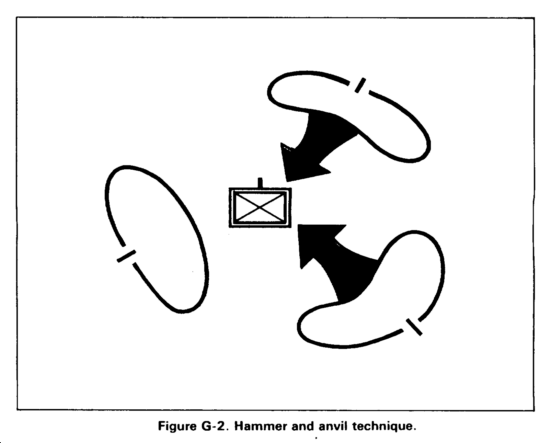
regardless of their superior equipment and drill training. The “hammer and
anvil” and “pincer movement” evolved as a result, two concepts which are at the
heart of modern armored warfare and hopefully, the tactics of 2nd
platoon.
Alexander
used fast maneuvering elements, heavy cavalry called Hetaroi (Companions), to
penetrate a particular point in the enemy line, charging deep into enemy lines
and encircling a part or the entirety of the enemy force, forming a “pocket” by
assaulting from the rear (the “hammer”), the enemy reduced by the “anvil” of
steadily approaching spearmen. This bold new method of using force relied upon
a highly trained, disciplined and cohesive fighting force, as the exposed
“pincers” (the attacks which penetrated and encircled the force) were
vulnerable to flanking attacks from the enemy’s own maneuver forces.
Alexander’s maneuver elements had to be better, for lack of a better word, than
their Persian equivalents, while also having the discipline and personal
courage to operate behind enemy lines until the main infantry force arrived to
relieve them from the front.
Alexander succeeded in
drilling the most elite cavalry force the world had yet seen, and deployed them
using his new tactics. The result was disastrous for the Persians, who were
accustomed to simply overwhelming their opponents with a massive numerical
superiority and lacked the training, linguistic cohesion and discipline to
quickly respond to the fast moving cavalry. In every battle the significantly
outnumbered Macedonians engaged the Persians, the Hetaroi would maneuver
outward from the flanks, penetrate the mass of the Persian line, face and
defeat the Persian’s own cavalry, charge deeply in and turn about to attack
from the rear as the impenetrable phalanx wall advanced steadily forward,
trapping the enemy force between a hammer and anvil. The result was eradication,
a fundamentally different outcome from the conflicts of attrition which had
come before this innovative strategy.
This
tactic became the “gold standard” of victorious armies up until the 20th
century, reaching an apex with the Prussian military tradition. By the First
World War enveloping attacks by cavalry had become impractical, as the weapons
deployed were capable of inflicting massive immediate casualties to flanking
forces, while the flanking elements remained nearly as soft as they had been in
the days of Alexander. Warfare once again became attritional, and the First
World War was soon dubbed “the war to end all wars” because it seemed
impossible to ever truly defeat a modern country’s army. The machine gun simply
dealt too many casualties: a tiny force, properly armed, fortified in a trench
system, could reliably defeat a superior force. Flanking movements of cavalry
were inhibited by deadly walls of interlocking automatic fire, trench systems,
barbwire and mines. The days of maneuver warfare seemed to be at an end, and
annihilation warfare with it.
In
the years preceding World War II Heinz Guderian, a German military theorist,
influenced heavily by his time as a Jaeger (‘hunter’ rapid assault infantry)
during the Great War, his time working in signals and supply companies during
the interwar period, the Prussian school of thought and the theoretical
doctrine of J.F.C. Fuller, helped to train and implement the first modern tank
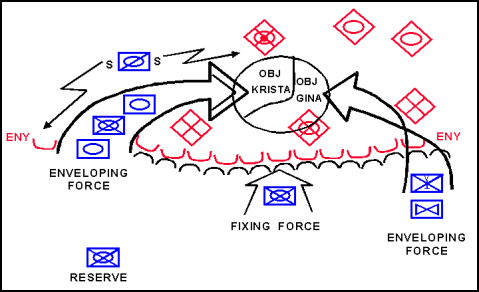
divisions. Guderian essentially
reinvented the “hammer and anvil” of the past ages with his concept of
“schwerpunkt” (focal point), attacking from the flanks with a new type of
cavalry resistant to casualties and focusing all local artillery and air
support at a specific breakthrough location to ensure successful penetration.
Once penetration was successful the 2nd stage of the action was
implemented: paralysis. During paralysis interdiction sorties, rapidly moving
armored elements and (possibly) airborne attacks were implemented to quickly
disable the enemy’s ability to respond to the encircling force and to destroy
the enemy’s logistical system. The last stage of the action was the “cauldron
battle” (Kesselschlacht) which included the tightening of a pocket around a
finally encircled enemy force and its eventual liquidation by a concentric
assault. To review:
1. Schwerpunkt:
A focusing of force at a particular point to achieve penetration
2. Paralysis:
Interdiction to disable enemy logistical and operational ability
3. Cauldron
Battle: The destruction of the paralyzed enemy force through encirclement.
Guderian’s doctrine of
armored warfare was hugely successful in the same way Alexander had been
against his shocked enemies some two millennia earlier: every enemy force which
the German military machine engaged was decisively defeated. During the opening
phases of Barbarossa massive pockets containing millions of encircled Russian
soldiers were liquidated using Guderian’s method, as entire army groups were
destroyed. His method was elegantly replicated at both corp and company level,
serving a coherently universal doctrine. It could be argued that the war itself
was not lost on the battlefield but defeat was more due to the bumbling
incompetence of the highest level of command: Hitler failed to set consistent
objectives during the most critical Russian Barbarossa campaign, and through
his delusional politics and absurd expectations, led the technically superior
German military to failure.
Today the theory of
Guderian has essentially become what the Macedonian way of war was to those who
followed in Alexander’s wake: the standard way of war. Most recently Norman
Schwarzkopf utilized Guderian’s tactics to stunning success in the Gulf War,
effectively destroying Saddam Hussein’s army through rapid maneuver warfare and
effective usage of close air support and interdiction. It is proposed that we continue this doctrinal legacy for 2nd
platoon, using armor as a mobile force to penetrate, paralyze, encircle and
destroy enemy forces.
The Culture of Command
For armor to be used
effectively a certain culture must exist at every level of command so that
friendly forces make decisions faster than the enemy forces and so outmaneuver
them. In other words: the friendly “decision cycle” must be more effective than
the “decision cycle” implemented by the opposing force. In ARMA, the decision
speed of OPFOR is not immediate, so this concept can be replicated with general
realism.
For the armor to be
most effective in combat 2nd platoon must utilize “directive
control.” Directive control involves a notification by superiors of intent and
the role to which the ordered unit must fulfill in the upcoming engagement. The
implementation of that intent (directive) then becomes a matter for the
low-level commander to determine, suited best to the situation on the ground.
In this fashion command burden is reduced at the highest levels and spread
among commands more knowledgeable of their own situation. In this fashion
significant decisions can be effected quickly, without burdening reliance on
high command’s consent and knowledge. Initiative is the virtue of maneuver warfare,
as it fosters implementation of the doctrine. Decentralization, assuming the
low level commands are properly trained beforehand, leads to victory over a
centralized and slow to respond opposing force.
Essential Support
For maneuver armored
warfare to be successful it must be supported with all the available air and
artillery resources during the opening phase (“Schwerpunkt”) of the action in
order to ensure penetration and consequent paralysis. Ideally armored platoon
leaders would be able to call for close air support and momentarily receive
effect on target. As pincer attacks are vulnerable to flanking attacks and
being pocketed themselves, proper reconnaissance is a must: armored platoon
commanders should have a reliable knowledge of the terrain and the opposing
forces before them, provided by scout elements. As the attacking spearhead must
think quicker than the opposing force, a lack of knowledge in this regard
results in delay, and at worst, an effective counterattack against the pincer,
resulting in loss of force. Delay is the vice of maneuver warfare, as in the
words of Guderian: “success must be exploited without respite and with every
ounce of strength, even by night. The defeated enemy must be given no peace.”
2nd platoon
must be the central focus of support during the initial stages of an attack:
all of the company’s resources must be at the platoon leader’s disposal, so
that a successful encirclement can be completed. The 227 must initially aid in
the ground attack of OPFOR elements opposing penetration, and once the armored
pincer is rolling behind enemy lines, switch to interdiction and reconnaissance
sorties so that the tank commanders can quickly outmaneuver paralyzed OPFOR
elements. As a practical example a platoon of OPFOR mechanized infantry, their
vehicles neutralized through interdiction fire, should not be destroyed by the
deeply penetrating armor force, but would better be bypassed so that the
armored force can complete encirclement of the greater OPFOR force. The OPFOR
mechanized element, already immobilized, can be liquidated by the “anvil” of
approaching infantry or BLUFOR mechanized elements.
Without
artillery, recon and aerial support tanks become expensive liabilities. The
armored encirclement does not succeed because it destroys the enemy force
itself, it succeeds because it outmaneuvers, outthinks and fosters the
paralyzing of the enemy force; it is tact rather than brute strength which
brings about victory.
Practical Example
The following is an
example of the doctrine in action: an AAR written by myself detailing the
capture of Dolores using a numerically inferior armored force to paralyze,
encircle and liquidate an enemy force. Originally from:
http://www.1st-cav.us/modules.php?name=Forums&file=viewtopic&t=5804
3/27/09 1755 est
Objective(s):
1)Capture Dolores
2)Effectively use Schwerpunkt tactics
3)Avoid losing our armor in the town
4)Avoid being bogged down as infantry support vehicles
5)Effectively plan and execute a urban assault without
disintegration, using the tanks strengths to our advantage
6)Get the new armor recruits used to armor combat
7)Utilize effective cover against armored OPFOR; improve
silhouetting
Roster:
In Attendance
1)PFC. Krause
2)SPC. Curtis
3)PVT. Levesque
4)PVT. Howe
5)PV2. Kirkwood
6)PVT. Mahon
7)SGT. Tyler
Weapons Used: Standard mechanized infantry pack, m-16/m4
with AT-4
Vehicles Used: 2 M1a1, 1 Harrier GBU (pre-op), 1 Repair
Truck
Pre-op History:
Captured Cayo under the command of SPC. Curtis with Sgt.
Tyler offering sporadic close air support via Harrier GBU. PVT. Mahon left
before the assault on Cayo was complete. After mustering our armored force we
arrived at the southern outskirts of Dolores, SPC. Curtis ordered an assault on
the town but had to leave. PFC. Krause took command.
Tank 1 (set left):
PFC. Krause (TC/Gunner)
PV2. Kirkwood (Driver/assistant TC)
Tank 2 (set right):
SPC. Curtis (TC/Gunner - left pre-op)
PVT. Mahon (Driver - left pre-op)
PVT. Levesque (Driver)
PVT. Howe (Gunner/TC)
Repair Truck (pre-op and setup):
PVT. Howe (Engineer)
Assault Fireteam 1:
PFC. Krause
2 AT paratroopers
2 Rifle paratroopers
1 SPOF paratrooper
1 MG paratrooper
Assault Fireteam 2:
PV2. Kirkwood
Assorted paratroopers
Operational History:
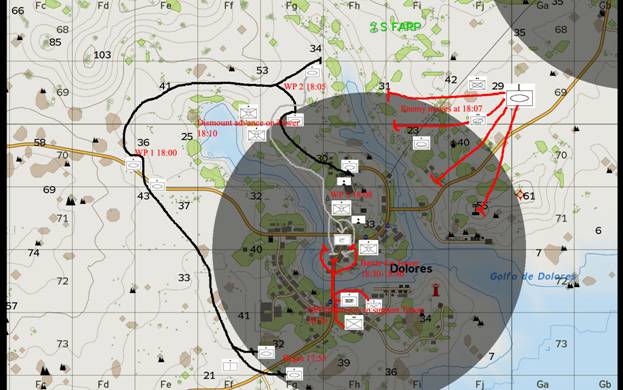
Full size: http://www.krauselabs.net/dump/aar2.JPG
17:55
Tank 1 and 2 form line in FG73 500 meters from rear
support truck and engage forward elements of OPFOR infantry while PFC. Krause
checks the map to plan the attack. It is decided to bypass the bridges and
avoid street to street fighting, an alternative plan is hatched. Completely
bypassing the urban center and river, Tank Force will overwatch at WP1 and WP2
in preparation for an assault on the radio tower. From WP2 road 69 will be
isolated from the town, barring mechanized and armor elements from relieving encircled
OPFOR infantry. The radio tower will be captured by foot elements and tank 2
while tank 1 overwatch road 69. Once the radio tower is destroyed, tank 2 is to
return to WP2 and reform line while foot elements secure town.
-
Go order is called, advance toward WP1 in column, both
tanks set right.
18:00
Infantry garrison and DH-30 engaged from overwatch WP1, as
infantry shifts toward the highlands advance is ordered to continue.
18:05
Tank 1 and 2 form overwatch line at WP2. Scattered infantry
contacts in the urban centre of Dolores, within 2 minutes OPFOR armored company
is detected advancing to relieve the town and is engaged. ZSU-24 and BMP
destroyed at Hill 23. Enemy rocket attack immobilizes Tank 1, PFC. Krause
orders dismount, orders Tank 2 to cover at WP3, set left toward Road 69.
Numerous BRDMs, BMPs, UAZs and T72s roll from the north and are destroyed while
PFC. Krause and PV2. Kirkwood muster paratroopers to take the tower.
18:10
Assault Fireteam 2 (Kirkwood) screens the advance of
Assault Fireteam 1 (Krause) toward Dolores centre.
18:12
DH-30 at WP3 (neutralized 18:05-18:10) captured, trained
at road north into town. OPFOR armored and mechanized elements continue to move
and engage Tank 2 - who use hill 30's barracks and strongpoints as enfilade
against downward fire. Assault Team 2 continues forward, engaging forward
elements of company-sized OPFOR infantry force advancing from hill 34.
18:20
DH-30 at Hill 33 (neutralized 18:00-18:05) captured and
trained at north road. Together with DH-30 at WP3 and Tank 2, 3 interlocking
cones of fire make advance by OPFOR armored and mechanized units into town
impossible. Sporadic small arms engagement by OPFOR and BLUFOR elements as
Assault Teams 1 and 2 approach and encircle the radio tower. Tank 2 is damaged
by enemy armor but is not immobilized or disabled.
18:30-18:40
Tank 2 continues to engage numerous armored and mechanized
targets, effectively using cover to cut off the armor advancing to relieve the
town, ensuring encirclement. The support DH-30s as well as Tank 2 run black as
the radio tower is finally reached by PV2. Kirkwood's team. Street-to-street
fighting commences between OPFOR Infantry Company and Assault Team 1 and 2
encircling pincers, heavy casualties are inflicted upon OPFOR. At 18:40 the
radio tower is destroyed by plastic explosives of PV2. Kirkwood.
18:40-18:60
Assault Teams 1 and 2, supported by Tank 2 secure the
town. Tank 2 becomes black on SABOT and HEAT.
Analysis
While
in the past 2nd platoon was used as infantry support, screening the
foot advance of infantry elements and often being used as AFVs in urban
warfare, contributing to the routine immobilization and destruction of said
vehicles. Armor was used in this example to isolate an urban centre from a
relieving force while the “anvil” of the slower elements secured the town. With
proper air support and additional armored fireteams, such an assault would have
even been more effective than it was. I have personally attended many assaults
on this same town headed by 1CD leadership where the old tactics had been
employed: a slow infantry-supported crawl directly into the town, with no
pincer movement or attempt to flank the enemy. The result was always the same:
being bogged down in street to street fighting with heavy casualties,
immobilization and abandonment of our tanks and prominence of the better
positioned enemy armored company.
Under
my command the town was bypassed entirely while the roads leading to it were
isolated by armor elements, the OPFOR elements stranded in town effectively
“encircled,” able to be slowly reduced by the anvil, with only one casualty
(ironically occurring during the assault on the town rather than the
encirclement). 2nd platoon’s armored pincer effectively cut off
access to the immobile enemy force from the north and west, while a natural
barrier of Dolores Golf provided the equivalent of a 2nd pincer
enveloping from the right flank.
This
is a mockup example of what becomes capable when using armored warfare
properly, and it was accomplished without complete crews, with only minimal
training by the 1CD members involved, and without inclusive air support.