Categories
Journal

Would we Americans have such a strong sense of patriotism and national superiority without mass mediums like radio and television?

Of course the typical American would not have the assumptions about the nature of the world if not for television and radio; such is a truism. It goes back to Plato’s constitution (Republic) and the importance of carefully selecting what unwise people are exposed to in order to save them from themselves. In our culture this sort of thing is considered undemocratic – but democracy fails if not informed by a healthy, wise populace. This is not to say that Americans would not have other assumptions without the influence of television, but they would not have unified, powerful delusions a la Leo Strauss. These latter sorts of delusions fuel the fires of absurd slaughter.

Categories
Journal

As the professor brought up in this week’s talking points- the Muslim influence on European academia is typically understated in our studies. I find this to be a compelling topic to discuss. I brought up last week the importance of Pagan works in monasteries and how they served as an intellectual foundation for the monks and the subsequent European academic culture. Yet last week I did not mention how the monks acquired these said works, and now I set out to do so. Following the collapse of the Roman empire in the west, much of the literary wealth was destroyed or relocated to the eastern portion of the Empire, centered at Constantinople (modern day Istanbul), leaving the west only a small remnant intellectual wealth. What follows is a simple history of the period.

A growing threat in the east, the Sassanid Persians (stretching to modern Iran to Iraq) began to clash with the east Romans, weakening both states. The peoples from the Arabian Peninsula (recently unified by infant Islam) seized upon this opportunity to mass and strike into Mesopotamia, occupying the lands previously held by the Persians. From the 6th to 10th centuries CE the Arabs sporadically warred with the east Romans, but also traded with them. Cultural diffusion took place, and the Abbasid domain became a place for contemplation and expansion of the Pagan works acquired by sword or silver from Byzantium. While the east Romans were effective librarians, they were not innovators intellectually, considering the Pagan works and philosophy in general to be detrimental to faithful Christian practice. Accordingly the Arabs became the intellectual power of the time, and revitalized the old Pagan sciences and philosophies, creating a cosmopolitan kingdom centered at Baghdad (The city of peace). During this period algebra and serious astronomy were created by Arabs, and their many commentaries on Pagan works, especially Plato and Aristotle, helped to preserve the past age’s wisdom and knowledge. The Abbasids and their successors were prolific copiers of ancient works, and created vast and elaborate libraries to house them. As a side note, their greatest library, the one at Baghdad, was destroyed by Mongols in 1258.

Social turmoil in Europe instigated the crusades by the end of the 11th century CE – and so Europe plundered the Levant. During the fourth crusade the undisciplined European forces even plundered Constantinople on the way to the region, looting manuscripts and other valuable works. These campaigns introduced into Europe the ancient Pagan works as a form of plunder and began the slow process of intellectual restoration leading up to the Renaissance.

Categories
Journal

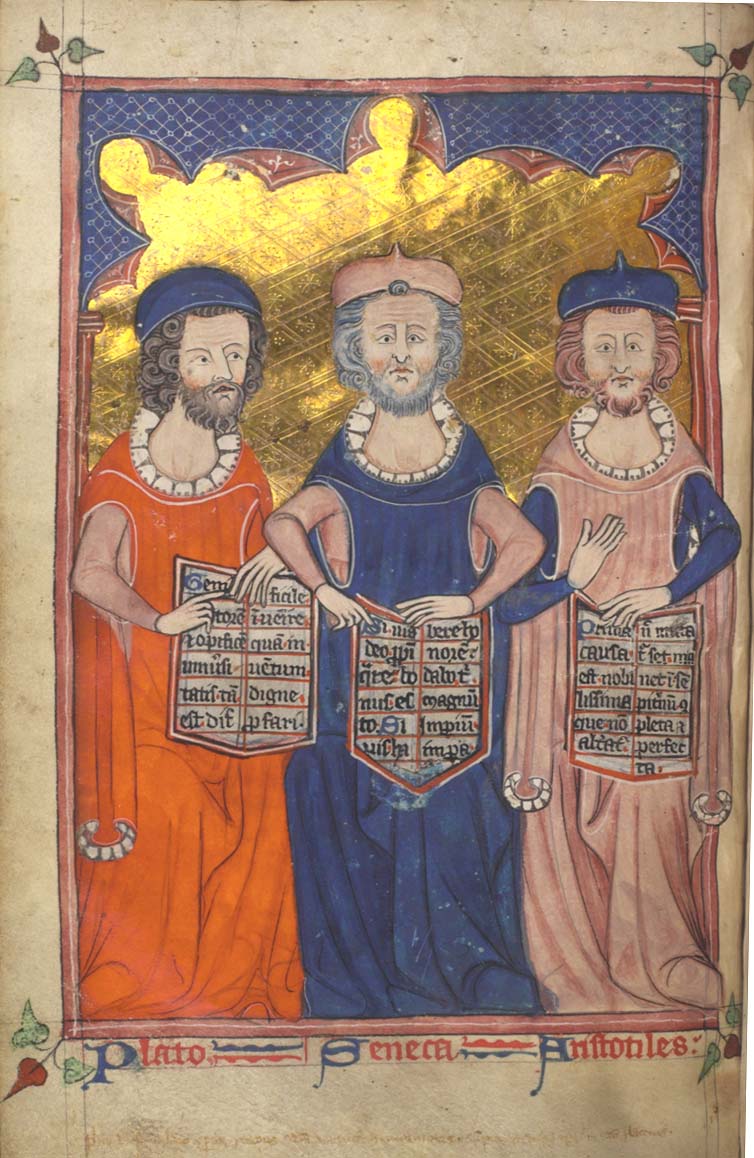
It was stressed in the lecture that the monks of the “dark ages” were keen with copying religious works in order to give glory to God – but something that I want to add is that the copying and understanding of these works was only made possible by the copying and reading of pagan works. We are told of latin manuals of style and grammar. These were not “textbooks” invented by the monks – but rather the great works of antiquity, typically Seneca’s letters, Vergil’s Aeneid and Cicero’s works (Logic, Grammar, Rhetoric respectively). The monks had an understanding of the Aeneid, considered the greatest extant vessel of the Latin language, comparable to their understanding of the great Book. The quadrivium was also informed by pagan works: Aristotle, Claudius Ptolemaeus and Plato. The monks ostensibly copied these “flea ridden” works in order to serve the church, but that doesn’t explain the reverence these works have attributed to them. Here’s an illuminated manuscript from the early 14th century depicting the intellectual pillars of the time:

Note: Thomas Aquinas is not pictured.

Thank goodness that the monks fell in love with these great works of antiquity – otherwise many of them would be lost to us today, and thus a great wealth of the liberal arts. In our time we tend to study these men as part of the ancient past (secluded into this field we dub “philosophy”), but during the age of the manuscripts they were synonymous with knowledge and history itself. The monks learned their disciplines and crafts by studying the ancient past and so derives the whole corpus of Christian writings. Amusingly, the dialectical methods the Christian apologists used and use to justify their faith derive from Seneca’s lineage of stoic logic, inherited from the Socratic line.

Categories
Journal

This week’s content, and especially the lecture, made me think of the relationship between tradition and technology. Another professor, whose class I am taking on preservation seems to posit the idea that technology will eventually obliterate tradition, i.e. writing replaced oral practice. I think Doctor Main’s ideas on this topic are more ambiguous – she reminds us of a strong oral tradition in several cultures, to say nothing of her own, that have flourished to outlast mere technological shifts. All of this reminds me of my studies of Herodotus, a figure who came into his own during the apex of Athenian cultural flourishing and the production of letters. Herodotus wrote down his histories using a new technology but nonetheless simply referred to them as tools to jog his memory in the working of the old oral tradition. Verily the histories of Herodotus were not read by anyone (besides the contemporary reader) but rather heard as oral lectures. Herodotus made his living by traveling from place to place giving lively lectures on his materials, in the epic tradition of Homer and Hesiod. In this case tradition and technology combine and do not obliterate one another. If anyone is interested in this topic – here’s a link to a paper I wrote about Herodotus in my ultimate semester as an undergraduate: http://www.krauselabs.net/?page_id=331

My next point is a meditation on the virtues of technology versus tradition. Are computers and writing clearly superior to the oral methods of our ancestors? I’m not so sure, as history shows us that oral societies had a greater deal of stability and fidelity as far as information retrieval are concerned. In pre-literate cultures a story was known by everyone in a society, and fidelity was checked by the memories of others. Myths and stories were considered important aspects of life, and so people carefully memorized what was being said. In this fashion if an error was recited it was quickly corrected by the collective memory of others. This cannot be said of modern times, in which what is known is a muddle, and modern day sophists (calling themselves “pundits”) spin lies around truths. The fidelity of knowledge is momentary and the whole idea of information retrieval is often based upon accident.

The memory-correction notion, if I may call it that, seems to me to have been reincarnated in such works as A People’s History of the United States, amongst others. Howard Zinn, who recently passed away (may he rest in peace), attempted to introduce the collective memory of people in order to reapply history. Although put to paper by one man, it is a consideration of the vast cultural heritage which has until recently been marginalized by “official” channels. All of this straddles fundamental philosophical questions including what is true and what is the way in which to report to others what is true.

A notable library science author once said, and I paraphrase, that in our current day and age it is possible for important records to become “lost in abundance.” This implies that as the whole sum of human knowledge, to mime Jimmy Wales, is digitized, the minutia and tedious everyday archives begin to drown out the otherwise noteworthy records which were re-recorded for generations due to their importance. These latter works are important, culturally, legally, economically, but are lost in an ocean of increasingly irrelevant records. What pains our ancestors took by hand copying ancient manuscripts of hundreds of leaves across generations to engender that information to us only to have it fall on obscurity because such stuff fails to break into the “trending topics” of Twitter. This topic came to mind upon reading Blossom and remains fresh at my attention even after musing through the other readings, which while informative, do not speak to the implications of endemic digital preservation.

On the topic of digitizing books a la Coyle. It’s great that we are slowly digitizing all books, but we must recall the harsh facts (summarized by Conway 2000) before throwing caution to the wind:
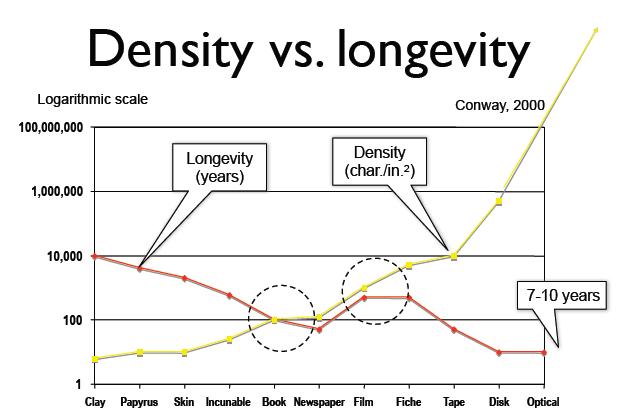
We must realize that digital data’s longevity is extremely unreliable, hard-drives die within a decade, and files themselves will degrade and become corrupt. Accordingly, if everything is to be digitized, we must consider the economy of constantly replacing devices which are created using plastics and other rare materials. Fail to replace such hardware, and the information contained upon them will be lost forever as hard copies are consumed by inherent vice and the slow corrosion of time. In order for this digital shift to be truly ethical, we must ensure that national data centers be established on the principles of redundant preservation: online, offline and offsite. Simply throwing a file onto a storage hard-drive is not enough, considering what is at stake. Mechanical failure means the obliteration of information, and without substantial effort given to making such information redundant, knowledge may be lost forever.

It also makes one think of the dangers of nuclear wars and/or catastrophic environmental phenomena which would have little effect on hard copies but devastating effects on digital collections. Indeed, the greatest destruction caused by a nuclear attack may not lie in the fallout or explosive effect, but rather the powerful electromagnetic pulse created by it:

Such a phenomenon, nuclear or natural, might mean the end of all knowledge as we know it in a completely digital world. In the end it may be wiser to continue to print hard copies while offering digital resources as options for access.
Categories
Journal

Some ember burns inside. Cato clutched his side on the slope leading up the forested path. Oceans of rock loomed over by sylvan sentries. The boys lie ahead, looking back at the knight. They are steeled. Dirt coats their faces and tunics. They are panting and holding themselves up on shaking hilts. The sky is darkening but cheeks and eyeballs pierce the shadows. Something is coming. His neck atrophied. He looks back but his eyes close like a man woke from a deep sleep by a shut door. Cato thought of the fox’s face before the hounds got to it so many years ago when his father brought him to the country. Cato reasoned then, this was not a foe to which he could contest. The path grew darker and like sweeping volcanic waves shadows made embrace of the stranded company. It was then seen.